Measure-and-correct vs a CNOT ladder for a 7-qubit GHZ state: a pre-registered FAIL
Plaintext article. SHA-256 27f3bc50b263ec9b21a8416d15e77daf58e3b0b5aa09137ca2a137bc82df3826 (13027 bytes).
# Measure-and-correct vs a CNOT ladder for a 7-qubit GHZ state: a pre-registered FAIL

**Quantum Mind A.I. · 2026-11-02**

## In short

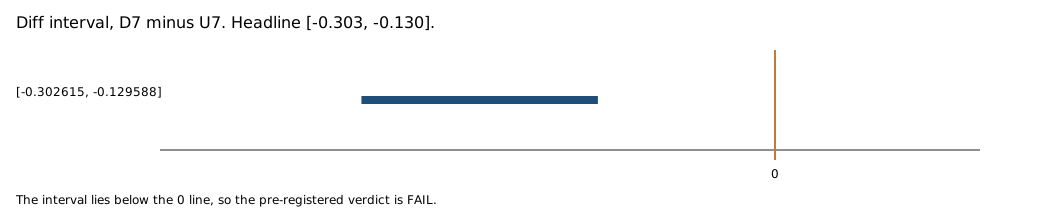
The question is whether a measure-and-correct preparation puts a seven-qubit GHZ state above a nearest-neighbor CNOT ladder. Quantum Mind A.I. ran both on IBM's 156-qubit ibm_fez processor, through IBM's Open Plan, in 15 seconds. The pre-registered difference interval is about -0.30 to -0.13. It lies entirely below zero, so the verdict is FAIL. The verdict covers this method on these qubits only. It is not a device certificate. The shorter pair is reported and does not decide.

## Why this comparison

A CNOT ladder's depth grows with the number of qubits. Measure-and-correct keeps the preparation shallow by measuring helper qubits mid-circuit and correcting the rest. The cost is more qubits, more two-qubit gates and mid-circuit measurements; here that is 13 vs 7 qubits, 12 vs 6 cz, and 6 vs 0 measures.

## How the comparison works

This is how the two preparations are scored, and only the seven-qubit interval decides.

The target is an even split of 0000000 and 1111111, written (|0000000> + |1111111>)/sqrt(2). U(7) prepares it with a nearest-neighbor CNOT ladder on the 7 logical qubits. D(7) prepares it with two layers of CZ gates on 13 qubits, an X measurement of the 6 ancillas, and Pauli feed-forward onto the 7 logical qubits. n=7 decides. n=5 is the same pair of preparations on the shorter prefix of the same path. A population term alone is not the primary score.

For one arm, N is 2048 on n=7 and 1024 on n=5. P0 and P1 are the shares of the all-zero and all-one keys. Parity score j is the even-bit shots minus the odd-bit shots, divided by N, on parity circuit j. The count key is c{n-1}...c0, and c0 is logical qubit 0. Missing keys count as 0. The witness is F = (P0 + P1) / 2 + (1 / (2n)) * sum_j (-1)^j parity score j. The ideal value on the target state is 1. F is reported unclipped.

The deciding statement uses 16 circuits: 8 for U(7) and 8 for D(7) feed-forward. Each gets a two-sided Clopper-Pearson interval at level 0.05/16. The population success is the sum of the two GHZ keys, and that interval is divided by 2. Parity j converts the even-count interval [L, U] to an E interval [2L - 1, 2U - 1], multiplies by (-1)^j, then by 1/14. The F interval adds the lower ends and adds the upper ends. That sum is an outer bound from the union bound, not the shortest interval. The diff interval's lower end is the D(7) lower bound minus the U(7) upper bound. Its upper end is the D(7) upper bound minus the U(7) lower bound. PASS only if D(7) feed-forward was not blocked, both n=7 arms are valid, and the lower end is strictly above 0. FAIL if both n=7 arms are valid and the lower end is not strictly above 0. The headline rounds the recorded diff interval to three decimals.

n=5 uses the same construction on its 12 circuits at level 0.05/12. Those intervals are published and do not decide. The passive circuits and the read-versus-act differences do not decide either.

## The result, recorded

These lines are the recorded seven-qubit scores and the interval that decides.

The run is on ibm_fez. The path P is 99, 115, 114, 113, 112, 111, 110, 109, 118, 129, 130, 131, 132. U7 uses P[0] through P[6]: 99, 115, 114, 113, 112, 111, 110. D7 uses all 13. The cap is 120 seconds. The fetch records 15 seconds. The deciding arms are 16 circuits at 2048 shots. The compiler settings are optimization level 0 and seed 20261102, with no dynamical decoupling and no session.

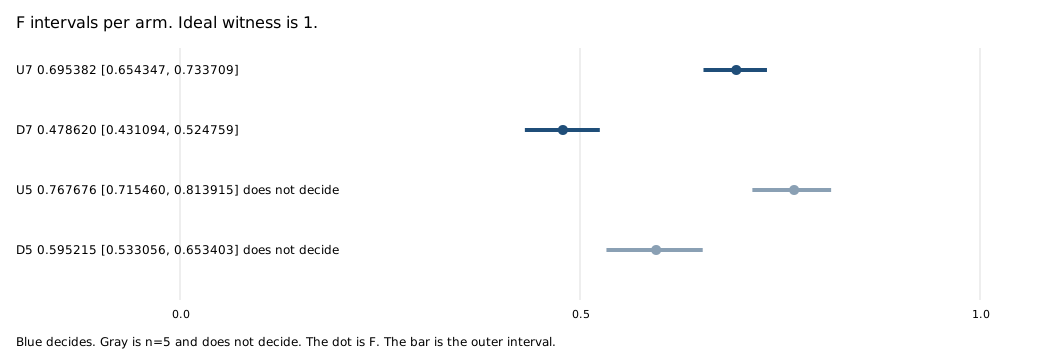
Recorded to six decimals, U7 F is 0.695382, interval 0.654347 to 0.733709, from 1588 all-zero plus all-one shots. The all-zero count is 897 and the all-one count is 691. D7 F is 0.478620, interval 0.431094 to 0.524759, from 1263 all-zero plus all-one shots. The all-zero count is 684 and the all-one count is 579. The recorded diff interval is -0.302615 to -0.129588. Its lower end is not strictly above 0, so the verdict is FAIL.

U7 parity scores, j = 0 through 6: 0.63671875, -0.6083984375, 0.609375, -0.619140625, 0.578125, -0.615234375, 0.640625.

D7 parity scores, j = 0 through 6: 0.4609375, -0.326171875, 0.318359375, -0.318359375, 0.34765625, -0.30078125, 0.3115234375.

## The path and the error budget

The budget was fixed with the path, before the shots. It is published next to the diff. It does not move the diff, and it is not a device certificate.

U7 touches 7 qubits, 6 cz gates, and 0 mid-circuit measures. The recorded sums on those qubits are cz 0.012410530900655053 and readout 0.13232421875. D7 touches 13 qubits, 12 cz gates, and 6 mid-circuit measures. The recorded sums on those qubits are cz 0.024413310207823974 and readout 0.23779296875.

## n=5, reported and not deciding

These rows repeat the comparison on five qubits and do not decide.

U5 uses P[0] through P[4]: 99, 115, 114, 113, 112. D5 uses P[0] through P[8], nine qubits, ending at 118. Each n=5 circuit has 1024 shots. U5 F is 0.767676, interval 0.715460 to 0.813915, from 859 all-zero plus all-one shots (476 and 383). D5 F is 0.595215, interval 0.533056 to 0.653403, from 753 all-zero plus all-one shots (396 and 357). These rows do not decide.

U5 touches 5 qubits, 4 cz gates, and 0 mid-circuit measures. The recorded sums are cz 0.008831345199888041 and readout 0.1142578125. D5 touches 9 qubits, 8 cz gates, and 4 mid-circuit measures. The recorded sums are cz 0.0165184120152283 and readout 0.13720703125.

U5 parity scores, j = 0 through 4: 0.73046875, -0.67578125, 0.703125, -0.673828125, 0.69921875.

D5 parity scores, j = 0 through 4: 0.529296875, -0.404296875, 0.447265625, -0.453125, 0.44140625.

## Read versus act

These point values separate the mid-circuit read from the feed-forward correction, and they do not decide.

Secondary, n=7 only. These point values sit outside the 16-circuit family. They do not change FAIL. dW_read is worded exactly "prep + mid-circuit read, on these qubits". dW_act is the feed-forward cost.

W_pop is (P0 + P1) / 2. On the passive population circuit the flips compose by XOR: ancilla bit k, counted from the right, flips logical bits 0 through k. W for the phi=0 parity is E_0 / 14, and that map does not flip bits. dW_read is the passive term minus the ladder term. dW_act is the feed-forward term minus the passive term. For each term, W_U + dW_read + dW_act = W_active.

Recorded population point values: dW_read -0.05615234375 and dW_act -0.023193359375. The ladder share is 1588/2048, the passive share after the flip is 1358/2048, and the feed-forward share is 1263/2048. Before that flip the passive all-zero and all-one keys sum to 45 of 2048. Recorded phi=0 point values: dW_read 0.0027901785714285754 and dW_act -0.015345982142857144. The three E_0 scores are 0.63671875, 0.67578125, and 0.4609375. Both identities hold exactly on these counts.

## Exploratory note

This is a later reading of the same counts, and it does not change the verdict.

Label: EXPLORATORY. This reading was not a pre-registered test, and it does not change FAIL. The independent recompute describes D7 as lower on both terms: population 0.617 versus 0.775, parity magnitudes about 0.32 versus about 0.61. It also reads the live feed-forward step as a cost of about 0.046 in population on these qubits. In these counts the population shares are 1263/2048 and 1588/2048, and the feed-forward gap against the flipped passive share is 95/2048. The mean absolute parity across the seven circuits is 0.34054129464285715 for D7 and 0.6153738839285714 for U7.

## What we learned

On this path the measure-and-correct witness finished below the CNOT ladder, and the pre-registered interval says so. The arm that finished lower is also the arm that touches more qubits, more cz gates, and the only mid-circuit measures. The design trades a shallow, fixed-depth preparation for extra qubits, extra two-qubit gates, and mid-circuit measurement with feed-forward. The ladder's depth grows with the number of qubits. At 7 qubits on this path, that trade did not pay. A fairer next test would sit where the ladder's depth costs more, or would compare paths with matched error budgets. This note does not promise one.

## Time on the device

IBM's Open Plan, one job, no session. The fetch records 15 seconds. The cap was 120 seconds. The job holds 30 circuits and 49152 shots: 12 circuits at 1024 and 18 circuits at 2048. The before-submit read records 571 seconds remaining, qualified true, and limit_reached false. That 571 is the before-submit field.

## Limits

FAIL is a result of this method on these qubits. It is not a device certificate. The F intervals are simultaneous outer bounds for sampling error under the stated split. They do not by themselves separate the witness from the larger D7 budget. n=5, the passive diagnostic, and the read-versus-act point values cannot turn this FAIL into a PASS. No readout mitigation, post-selection, discarded shots, or adaptive shots entered the score.

For the true state, a fidelity above one half rules out every state that is not genuinely 7-qubit entangled. These are raw scores, with readout error included, from one run. This note does not claim that U7 is genuinely 7-qubit entangled, or that D7 is not.

## Figures

The four F intervals are figures/f-intervals.svg. The diff interval and the 0 line are figures/diff-interval.svg. build_figures.py draws both from COUNTS.json and FETCH.json alone. It recomputes F, the outer bounds, the diff, and the two read-versus-act identities from the counts, and it stops if those values disagree with the fetch.

## Provenance

Recorded to six decimals, U7 is 0.695382 [0.654347, 0.733709] and D7 is 0.478620 [0.431094, 0.524759]. The diff is [-0.302615, -0.129588], and the headline rounds it to [-0.303, -0.130]. n=5 is 0.767676 [0.715460, 0.813915] and 0.595215 [0.533056, 0.653403]. Every exact value is below.

### Sources

1. Input copy manifest sha256 0c38b4a1e1d369724488ca28d077c34fd74fc1af2950ac2f52fb1d89ee64fac5. shasum -c was OK, 13 files. That copy was not edited.
2. COUNTS.json sha256 ffb94145813b6f832e2a40786e5d1906466fdbe1b05b485b558715be02907a8b. FETCH.json sha256 1868b59ee188c34b990d361836b465c88248df2043695264648e0dc34bb6bbfe. The counts copy manifest file sha256 is 81fe853946d4de73d2c1d063b6537778d5757d37a115cbac2cf32ec42c9c6f89.
3. COMPILE.json sha256 55ce6cd18ea930f32031435b69cae4071ace73ad587607a90248ffa68e01b85a. SUBMIT.json sha256 7c3e09b3383fd9ac164543e22f851ad1d99ccfd4f3f0d3168301da08aa252e32. The figure builder does not read these two files. The path and the error sums come from the compile identity.
4. PREREG.md sha256 9f6421cd8a56403b3c2cd9f20daeccdafab02d105621556981422606cfa32c0d. sim_check.py sha256 933ccbdd46aca4f9b6c67f9502090db5770fa10c4bb6524c3849e93b127f8258. SIM_OUTPUT.txt sha256 2cbfa7d3fef08dd2425fc8b96fa8595585bc2f63abbec8289fc3d8504e6ac1b1. The prereg copy manifest file sha256 is b707d748ae89789b7a50d278f2d7738300c5869de6700a50112e6acf4f54a7ee.
5. Job on ibm_fez, plan open. Job dbkar2pkdqps73923oig, usage_seconds 15, cap 120, 30 circuits, shots 12 x 1024 and 18 x 2048, seed 20261102, optimization level 0. Identity sha256 71b0ccde0f21d472894f296950df82f67b1afc0112e38c6b33eb41b21b675485. The counts file records run_p2 sha256 a29d6838f414526a5af1c59b94fd01f90cd84384b6e3fd1720516f9774410c71. The before-submit read records qualified true, limit_reached false, and 571 seconds remaining.
6. An independent recompute from the prereg rules agrees with the fetch: max absolute gap 5.7e-15, verdict MATCH, and the same FAIL. That recompute is bus event 929e7846-355c-4cc2-8c43-5729c340ffd5. Its saved text sha256 is eb959387f79e6749609eccf99cc184ccf0246bed0431eef0a14844f00b888400.

### Exact values

U7. P0 897/2048. P1 691/2048. pop_k 1588. F 0.6953822544642858. Interval 0.6543474519953487 to 0.7337088852375814. E_j 0.63671875, -0.6083984375, 0.609375, -0.619140625, 0.578125, -0.615234375, 0.640625.

D7. P0 684/2048. P1 579/2048. pop_k 1263. F 0.47862025669642855. Interval 0.43109365021999946 to 0.5247593386281257. E_j 0.4609375, -0.326171875, 0.318359375, -0.318359375, 0.34765625, -0.30078125, 0.3115234375.

Diff. Lower end -0.3026152350175819, equal to the D7 lower bound minus the U7 upper bound. Upper end -0.12958811336722298, equal to the D7 upper bound minus the U7 lower bound. Headline [-0.303, -0.130]. Verdict FAIL.

U5. P0 476/1024. P1 383/1024. pop_k 859. F 0.76767578125. Interval 0.7154604597171117 to 0.8139147350248617. E_j 0.73046875, -0.67578125, 0.703125, -0.673828125, 0.69921875.

D5. P0 396/1024. P1 357/1024. pop_k 753. F 0.59521484375. Interval 0.5330556477821156 to 0.6534029286874922. E_j 0.529296875, -0.404296875, 0.447265625, -0.453125, 0.44140625.

Read versus act. Passive flipped pop_k 1358. dW_read population -0.05615234375. dW_act population -0.023193359375. dW_read phi0 0.0027901785714285754. dW_act phi0 -0.015345982142857144. Passive E_0 0.67578125. Unflipped passive GHZ keys 28 and 17.

The witness is F = (P0 + P1) / 2 + (1 / (2n)) * sum_j (-1)^j E_j.
Figures