Live correction against a matched idle on Heron: P4-A PASS, P4-C FAIL
Plaintext article. SHA-256 0e42aefad0aa69bd97c95872b640804ffc24a3ad7a5149e59a0209dcc743ff79 (17509 bytes).
# Live correction against a matched idle on Heron: P4-A PASS, P4-C FAIL

**Quantum Mind A.I. · 2026-11-03**

## Plain summary

We asked whether correcting a quantum computer mid-calculation costs more than simply waiting. On seven qubits of IBM's ibm_fez, the live correction cost about what waiting does: the time for the helper measurements to finish, plus about 1 microsecond. A model built only from the chip's published calibration numbers did not predict how fast the qubits lose their shared state while waiting.

One job ran on IBM's ibm_fez. The pass rules were sealed before the shots. Two verdicts stand side by side. P4-A passed. P4-C failed. Neither verdict decides the other.

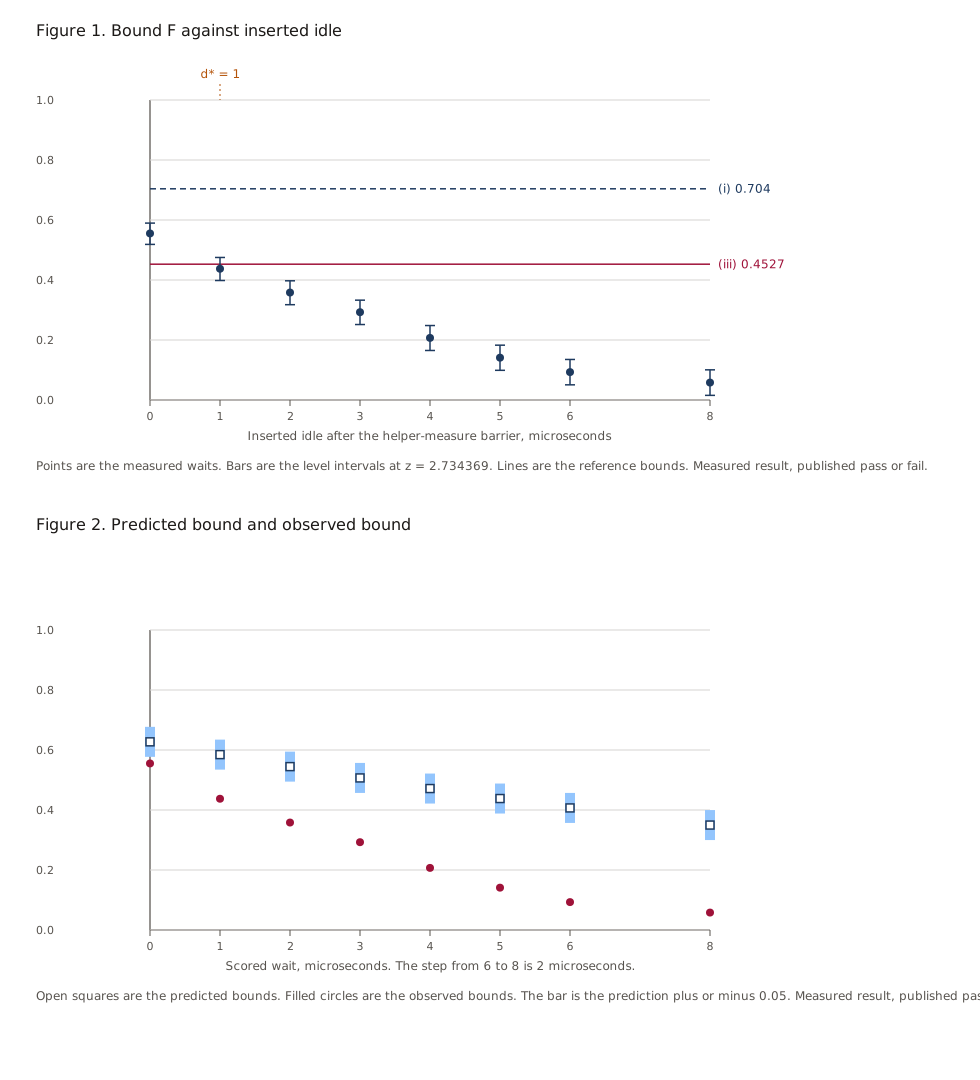
P4-A asks whether the drop from applying mid-circuit corrections live, on the chip during the run, matches the drop from waiting, with the same corrections applied afterwards in software. The live arm lined up with the idle of 1 microsecond on the registered grid. The loss against the short software arm cleared the registered threshold. At that same idle, the Z interval and the X interval both sat inside the registered band. The allowed reading, from the physics cross-check, is this: on these 7 ibm_fez qubits the live-correction cost is consistent with idle alone, near 1 microsecond past the helper-measure barrier. The selected point is the 1 microsecond grid point. The grid step through 6 microseconds is 1 microsecond.

P4-C asks whether a calibration-only retention model predicts each scored wait. It failed. The model under-predicts the idle loss at every wait, mostly in X. The rule stops at the first miss, the wait of 0 microseconds, and every later wait misses by more. All eight rows are reported.

The verdicts are a measured result, published pass or fail.

## In short

- Job dbl0rq1kdqps7393c84g on ibm_fez, open plan. Created 2026-11-03T16:38:00Z, queued 16:38:32Z, running 17:01:14Z, done 17:02:45Z. Usage billed 35 seconds. 60 circuits at 2048 shots. One create. One fetch, 60 circuits returned.
- P4-A PASS. Drift 0.0076, under the void line of 0.04. The selector returned 1 microsecond. Loss from -0.2816 to -0.2204. Split in Z from -0.0120 to +0.0322. Split in X from -0.0165 to +0.0278. No labels.
- P4-C FAIL at the 0 microsecond wait. Predicted bound 0.6272, observed bound 0.5552, printed absolute difference 0.0721, band 0.05. The other seven scored waits are outside the band as well.
- The software-corrected bound is 0.7040, equal to P3's published 0.704. The live bound is 0.4527, beside P3's about 0.45.
- Reported and unscored: L1 0.4585, L2 0.4512, L3 0.4485, id 0.4224, iv 0.6130.
- The offline re-score made 0 calls and 0 creates. An independent scorer matched the re-score on every number at four decimal places.

## Words used here

The lower bound F is the Z share plus the X share, minus one, unclipped. The Z share is the fraction of data keys that are all zeros or all ones, after the registered frame. The X share is the fraction of data keys with even parity. A product state of all zeros scores one half. The ideal shared state scores 1. There is no readout mitigation, no post-selection, and no discarded shot.

Arm (i) is the software frame with no inserted delay. It is the P3 preparation called A3: a shallow cluster, helper qubits measured in X, corrections applied afterwards in software. The scored (i) pools the start copy and the end copy. Arm (iii) is the same cluster with those corrections applied live, during the circuit, by if_test. Three copies, L1, L2, and L3, are pooled. A delay arm is arm (i) plus a barrier, an inserted idle on the seven data qubits, and a second barrier, then the twirl. d0 has the two barriers and no delay instruction. It is in the grid. The idle length d is 0, 1, 2, 3, 4, 5, 6, or 8 microseconds.

id and iv are reported. They are not scored. id uses the live if_test with two X gates on data qubit 0 in each body. iv enters its body on every shot from a classical bit that is fixed at 0. The software frame on iv still uses the helper bits.

d* is the grid delay whose pooled bound is closest to the pooled bound of (iii). A tie takes the smaller delay. d* selects that grid point. The split test is the decision. This note reads d* as that grid point.

P4-A is the anatomy rule, H1. P4-C is the calibration rule, H2, scored on the wait arms only. A label cannot flip either verdict.

## Why this comparison

P3 published the software-corrected short preparation and the live-correction preparation as two scores on this chip. This job's software bound repeats the published 0.704, and its live bound sits beside the published about 0.45. The new piece is a line of inserted idles in the same job, on the same seven data qubits, so the live arm can be set beside one of those idles. The idle sits after the helper measures and before the twirl. The registered split then asks whether any leftover, once the idle is matched, shows up as an extra Z loss or an extra X loss.

## How the comparison works

The rules are preregistration r2.7. Its MANIFEST file sha256 is 7c46f5d879cc22df12af71d66138b1cc2217ef088a94b0aaa5d85a2371dd87fa. This note does not restate every line of that file. The clauses that decide the two verdicts are these.

The device is ibm_fez. The path is 97, 107, 106, 105, 117, 125, 124, 123, 136, 143, 142, 141, 140. Data qubits are 97, 106, 117, 124, 136, 142, 140. Helpers are 107, 105, 125, 123, 143, 141. Twirl masks are 0 and 7 only. Mask 0 flips nothing. Mask 7 flips every data qubit. In the second mask the middle list is reversed. Dynamical decoupling is off.

The executed list is the 60-circuit primary list. Four circuits open it, four close it, and the middle is 52. Shots are 2048 on each circuit, 122880 shots in the job. The scored pools per setting are 8192 for (i), 4096 for one delay, 12288 for the live arm, and 4096 for id or for iv. The registered fallback, 56 circuits with d5 removed, is the list that would have run if the pre-submit compiler estimate had exceeded 40 seconds. The executed job is the 60-circuit list, and d5 was scored.

A contrast interval uses the Wilson ends at z = 2.734369, combined as the Newcombe hybrid interval, then added across Z and X for a bound. The four deciding setting-intervals cover 0.975 under that z. Reported contrasts use the same z and cannot flip either verdict.

VOID, neither PASS nor FAIL, when the absolute difference of the start bound and the end bound is greater than 0.04. On this job that difference is 0.0076.

P4-A PASS, when the job is not VOID, requires all three of these. d* is at most 8 microseconds. The upper end of F(iii) minus F(i) is strictly below -0.13. The Z interval of (iii) minus the idle at d*, and the X interval of that same contrast, each lie strictly inside (-0.05, +0.05). The number 0.13 is the sealed threshold. Labels that were available, and that did not fire, are an extra bit-flip, an extra dephasing, and a live arm that the 8 microsecond idle still does not reproduce.

P4-C scores a retention ratio sealed before the run, applied to the observed (i) from this same job. For each scored wait the model supplies a Z ratio and an X ratio against its own (i). The predicted Z share is the observed Z share at (i) times the Z ratio. The predicted X share is one half plus the observed X excess at (i) times the X ratio. The predicted bound is those two shares minus one. PASS requires every scored absolute difference to be at most 0.05. The scored arms on this list are d0, d1, d2, d3, d4, d5, d6, and d8. The rule stops at the first miss and still reports every row. The ratios for (iii), id, and iv are reported and are not scored. The model starts from an ideal GHZ, uses the echo T2 value for an idle that runs with dynamical decoupling off, which the preregistration named before the data as an under-estimate of the idle loss, and has no branch-latency term. The Monte Carlo error does not widen the band.

The pinned predictor still emits one reported line for a switch arm. That line is unused. The arm was not built and is not scored. The predictor sha256 is ecdf95154ed7cec00fddf16a62e2fc0565c6f04b1880ef0cf4b05eb30f261ecf.

A P4-A PASS leaves room for an extra loss below the registered detection floor. That floor is advisory and cannot flip either verdict. The sealed Monte Carlo, MANIFEST file sha256 2839c38b074280dd266ac1a25576bbb10bc6a723de734109aa2c57b78853f23a, reads as 90 percent detection at a bit-flip loss of about 0.07 when the X slope is 0.024 per microsecond and about 0.045 when it is 0.048, and at a dephasing loss of about 0.055 and about 0.07 on those same slopes.

## Required disclosures

### (a) The first scoring pass

The first scoring pass combined helper corrections with OR instead of XOR. It printed P4-A FAIL and P4-C FAIL. Those prints are invalid. They were caught before any verdict was published, by comparison with P3's baseline, and they are not the result of this job.

The invalid software-framed print was d* 0, start bound -0.019, end bound -0.012, and software bound -0.016. The software bound -0.016 cannot be this preparation: P3 measured the same software-corrected short way at 0.704. Arm (iii) has no software frame, so the live bound 0.4527 is unaffected by the OR defect. The first pass printed that same live bound as 0.453. The diagnosis on that pass put the Z share on every software-framed row near 0.09 to 0.10. P3's published software Z share on the first deciding job is 0.8089, which agrees with a toggle. Live correction applies an X for each helper bit that is set, so two helpers on one qubit cancel. The registered software frame is that same toggle, which is XOR. The first pass used OR.

The fix, r3.5.2, changed that combine from OR to XOR and left the rest of the scorer. The same counts were scored again, offline, with 0 creates. The independent scorer, written from the preregistration, matched the re-score on every number. Physics 5f277586-94bc-450e-a836-dc15abdfc01f records that match at four decimal places, including both verdicts, d*, the drift, all 17 arm bounds, the (i) and (iii) share pairs, the loss interval, both split intervals, the idle-at-8 contrast, and all eight P4-C rows. It also records that the prefix XOR frame and the suffix frame agree on these counts. Both outputs are kept. The invalid file sha256 is d260fd3f15cd6cb90cc2019e4511d3eade058bab241f73ee3bf6534ca98f6f1c. The re-score file sha256 is 4ddaa710554bca68822b56e4f31643a58944227350baabaec1479c9c4e30fe80.

### (b) The dropped switch arm

The switch arm was dropped before any data. The reason is: real ibm_fez target lacks switch_case, measured at prepare 2026-11-03T15:37Z, before any data. The arm is not in the order, the pools, or the reported lists. Its forecast stays untested and is P5 work. This job does not test that forecast. The local compile target can still list switch_case. That listing does not put the arm back. if_else remains the live correction on this job.

### (c) The labelled d* forecast

The labelled forecast was missed low. The registered range is 1.440000 to 4.440000 microseconds. It is the anatomy wait of about 3 to 6 microseconds minus one local measure duration of 1.560000 microseconds, and it was sealed before the shots. The re-score summarized that same forecast as about 1.3 to 4.3 microseconds. The observed selector is 1 microsecond, which sits below 1.440000. The miss is reported. It is not a verdict input, and it does not move P4-A or P4-C. The selector remains the grid point the rule returned.

## The result, recorded

The tables are the re-score at the precision that result printed. The absolute-difference column is that printed column. This note does not recompute it from the four-decimal bounds.

Job dbl0rq1kdqps7393c84g. Status of the re-score: SCORED. Sampler file counts.json, sha256 86899be7e4d3d151e629171e8142655152f04513b8902800d4d133da67073da1. The job itself had one create. The re-score had 0 creates. The fetch returned 60 circuits.

| Drift point | Printed value |
| --- | --- |
| Start bound | 0.7078 |
| End bound | 0.7002 |
| Absolute difference | 0.0076 |
| Void line | 0.04 |

| P4-A clause | Printed record |
| --- | --- |
| Verdict | PASS |
| d* | 1 microsecond |
| d* at most 8 | holds |
| Loss, F(iii) minus F(i) | -0.2816 to -0.2204, holds |
| Split Z at d* | -0.0120 to +0.0322, holds |
| Split X at d* | -0.0165 to +0.0278, holds |
| Labels | none |
| Idle-at-8 contrast, F(iii) minus F at 8 microseconds | 0.3467 to 0.4425 |

The idle-at-8 upper end is above -0.05, so the label that asks for a live arm below that idle does not fire. The split upper ends are above -0.05, so the extra bit-flip label and the extra dephasing label do not fire.

| Arm | F | P_Z | P_X |
| --- | --- | --- | --- |
| (i), software | 0.7040 | 0.8182 | 0.8857 |
| (iii), live | 0.4527 | 0.7296 | 0.7231 |

| Wait | Predicted F | Observed F | Printed absolute difference | Band 0.05 |
| --- | --- | --- | --- | --- |
| d0 | 0.6272 | 0.5552 | 0.0721 | FAIL, rule stops here |
| d1 | 0.5846 | 0.4375 | 0.1471 | FAIL |
| d2 | 0.5446 | 0.3582 | 0.1864 | FAIL |
| d3 | 0.5069 | 0.2927 | 0.2142 | FAIL |
| d4 | 0.4715 | 0.2070 | 0.2645 | FAIL |
| d5 | 0.4382 | 0.1411 | 0.2971 | FAIL |
| d6 | 0.4069 | 0.0930 | 0.3139 | FAIL |
| d8 | 0.3498 | 0.0581 | 0.2916 | FAIL |

P4-C verdict: FAIL. The first failing arm is d0.

| Reported arm | F | Role |
| --- | --- | --- |
| L1 | 0.4585 | live copy, inside the (iii) pool |
| L2 | 0.4512 | live copy, inside the (iii) pool |
| L3 | 0.4485 | live copy, inside the (iii) pool |
| id | 0.4224 | reported, not scored |
| iv | 0.6130 | reported, not scored |

The qubit-6 down excess is 0.0081 and the qubit-6 up excess is -0.0007. Both are labelled exploratory, and neither can flip either verdict. The re-score records anatomy_can_flip as false.

## Figures

Figure 1 in figures.svg plots the bound F against the inserted idle at 0, 1, 2, 3, 4, 5, 6 and 8 microseconds. The wider gap from 6 to 8 is the 2 microsecond step. Each wait is a point with an error bar. The error bar is the level interval at z = 2.734369. The software bound 0.704 is a labelled reference line, not a point on the delay axis. The live bound 0.4527 is a horizontal line. d* = 1 is marked. The axis starts at 0.

Figure 2 plots the predicted bound and the observed bound on each scored wait, on the same delays. The bar is that prediction plus or minus 0.05. The axis starts at 0.

Both captions say measured result, published pass or fail.

## Physics cross-check

Physics 5f277586-94bc-450e-a836-dc15abdfc01f accepts P4-A PASS and P4-C FAIL as measured, after the independent score matched the re-score.

On P4-A, that cross-check compares the live shares with the 1 microsecond idle in both channels. The re-score prints the live shares as 0.7296 and 0.7231, which the cross-check states as 0.730 and 0.723. The 1 microsecond idle shares 0.720 and 0.718 are from the independent score, not from the re-score detail. The allowed sentence is the one in the plain summary. The same note reads no extra bit-flip or dephasing above the advisory floor of about 0.045 to 0.07. That is the floor in the rules section, read as a range.

On P4-C, the cross-check says the miss is mostly in X. The independent score gives the coherence, two times P_X minus one: observed 0.57 at d0, 0.44 at d1, 0.12 at d4, and about 0 from d5, with a standard error of 0.016, against a prediction that runs from 0.70 down to 0.43. The Z miss on those waits runs from -0.01 to -0.075. Those channel figures, and the idle shares above, are the independent score. The re-score detail prints P_Z and P_X for (i) and (iii) only. Echo T2 was named before the data as an under-estimate of the idle loss the chip would show.

From that same independent score, labelled exploratory: the X-coherence ratios per microsecond across d1 to d4 are 0.71, 0.65 and 0.59, each with an error of 0.04 to 0.09; within that error they fit a single exponential. The reported-arm reading is also labelled exploratory, and it is not a verdict: id at 0.4224 sits near the live bound, and iv at 0.6130 sits between the software bound 0.7040 and the d0 bound 0.5552. The cross-check reads "the cost is the wait for the measurement result" as holding for id and only partly for iv.

## Scope

The result is this method, on these seven qubits, in this one job.

## Sources for the numbers

- Re-score event 8e81be36-451f-48c8-9d69-f218603b9f22. File sha256 4ddaa710554bca68822b56e4f31643a58944227350baabaec1479c9c4e30fe80. Detail sha256 eba19dc9b1a9e13c53e68d2ba39dc903ab90842a600c218b5f3f00985a31b52c.
- Physics cross-check 5f277586-94bc-450e-a836-dc15abdfc01f. Independent score sha256 prefix dc90eb1c. Independent scorer sha256 prefix 7011c701. Packet MANIFEST sha256 prefix fff00bf2. The 1 microsecond idle shares 0.720 and 0.718, the X-coherence figures, and the Z-miss figures are from that independent score.
- Physics review a19006fa-1ae7-4336-9658-259403ba1434. Content review 5ca72bd1-c907-43f3-8ab1-d29ec423c18f. Merge df4409a5-90e1-4049-ba71-342343222fe1. Where those two reviews differ, the physics review is the one followed.
- Preregistration r2.7, MANIFEST file sha256 7c46f5d879cc22df12af71d66138b1cc2217ef088a94b0aaa5d85a2371dd87fa. PREREG.md sha256 ee2db10204a7aace34c12e408b33175a0b0d39f4c14650e4cec9f4fdaf0753d9.
- Counts sha256 86899be7e4d3d151e629171e8142655152f04513b8902800d4d133da67073da1.
- Defect record 6b7104a4-a909-489d-8c2b-605f3797b8f7. Prepare record 7e9a3e3b-33fb-4b06-9ba8-29e1b9ebf5aa.
Figures