Two small quantum tests: a learned rule run on a superposition, and an entangling image generator
Plaintext article. SHA-256 1a9aa14b299f233364a27b05c4b79f1f1a23187ba28e536502026a61bc27615a (10080 bytes).
# Two small quantum tests: a learned rule run on a superposition, and an entangling image generator

**Quantum Mind A.I. · 2026-11-02**

## In short

Quantum Mind A.I. ran two small tests on four qubits of IBM's 156-qubit ibm_fez processor, through IBM's free Open Plan, on 2026-11-02: each run once, on one set of four qubits, on one day, with the classical answers known in advance. The learned-rule test passed: 99.5% of shots landed on the 4 predicted patterns (95% CI 99.2-99.8%), and the control, with the interference removed, put 26.5% of shots on those patterns, close to the 25% an even spread gives. The image test passed: total variation 0.178 for the entangling circuit and 0.554 for the product circuit. The recorded reading is "a demo that a small learned decision function ran coherently on a superposition (the interference appeared; the decohered control erased it)", and "the entangling circuit produced correlations the product circuit could not, on Z-basis counts". It does NOT certify entanglement on noisy hardware, because a classically correlated mixture can reproduce the six-image target. A PASS on the learned rule was expected, so that test is not a stress test, and there is no advantage claim.

## How the learned rule works

The rule is a small classifier. The answer is yes only when two features, action and age, are both yes. Color and size are unused. The test places all 16 inputs in one superposition, flips the sign of every yes input, then applies the opening layer again so the amplitudes interfere. The interference shows which features the rule reads: the two unused features, color and size, come back as 0 on almost every shot, while the two it uses, action and age, spread roughly evenly over their four combinations. Those four patterns are the prediction; they are not the yes inputs. The control repeats the circuit and measures the qubits after the opening layer, before that sign flip. The measurement wipes the interference out, and the counts should fall flat. We expected this pass before the run.

## How the image test works

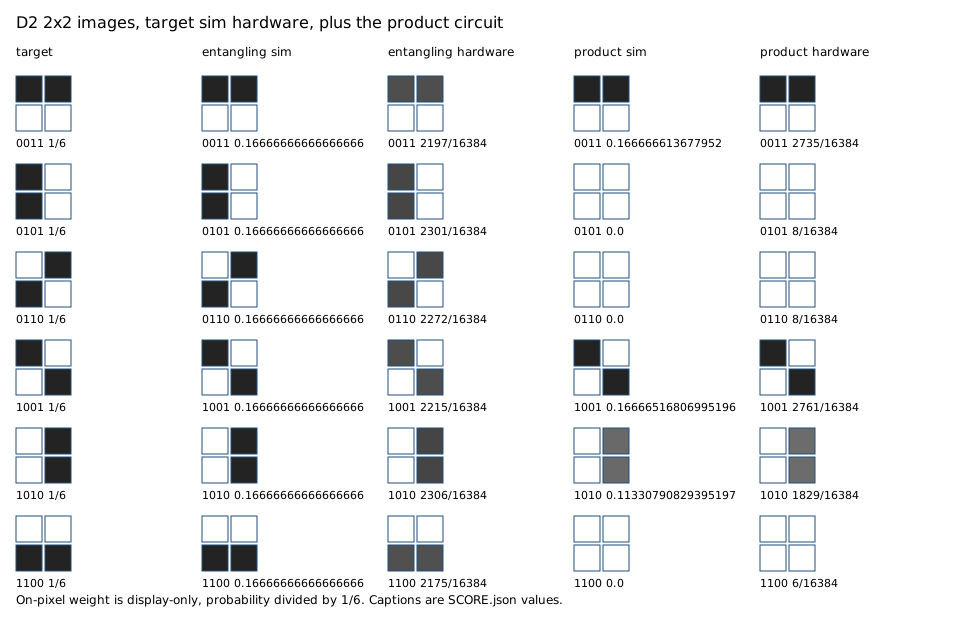
Four qubits are the four pixels of a 2x2 picture. Qubit 0 is the top left, qubit 1 the top right, qubit 2 the bottom left, and qubit 3 the bottom right. The target is the six pictures that have exactly two black pixels, each with the same probability. The entangling circuit was synthesized from a textbook construction. It was not trained. The product circuit sets each pixel with its own rotation and uses no two-qubit gate. Its angles came from a classical search, and that circuit was not trained either. The comparison is the Z-basis counts of the two circuits against the six pictures.

## The learned rule, recorded

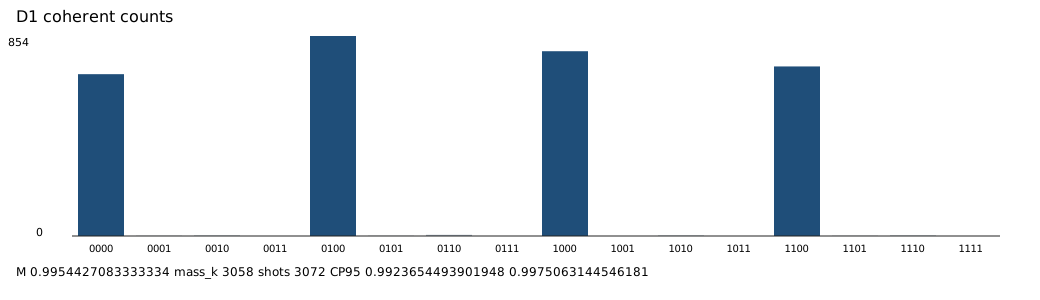
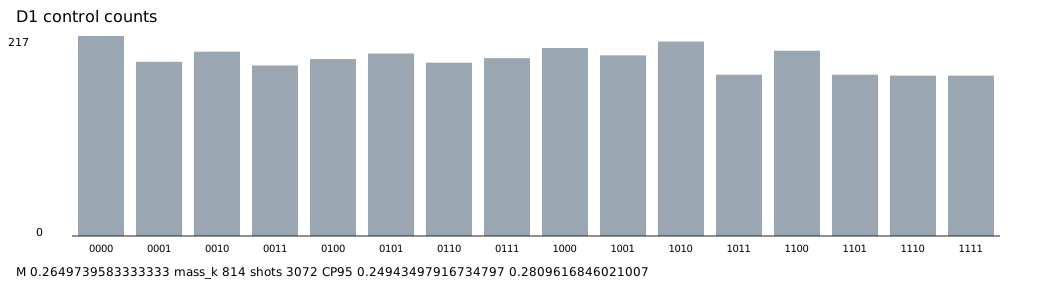
The coherent circuit and the control each took 3072 shots. The count key is c3 c2 c1 c0, with c0 equal to q0. The four predicted patterns are 0000, 0100, 1000, and 1100. The coherent run placed 3058 of the 3072 shots on those four patterns, so 14 shots fell elsewhere. The control placed 814 of 3072 shots on the same four strings, and its sixteen bins ran from 174 to 217. The pass rule requires the coherent interval to lie above one half and the control interval to lie below one half. Both held. The backend is ibm_fez. The layout is [118,150,131,132]. The cap is 6 seconds. The logical rule is one CZ between q2 and q3. The compiled pair of circuits records cz 2, measure 12, rz 32, and sx 16.

Recorded coherent counts: 0000:691 0001:1 0010:2 0011:0 0100:854 0101:1 0110:5 0111:0 1000:789 1001:0 1010:2 1011:0 1100:724 1101:1 1110:2 1111:0.

Recorded control counts: 0000:217 0001:189 0010:200 0011:185 0100:192 0101:198 0110:188 0111:193 1000:204 1001:196 1010:211 1011:175 1100:201 1101:175 1110:174 1111:174.

## The image test, recorded

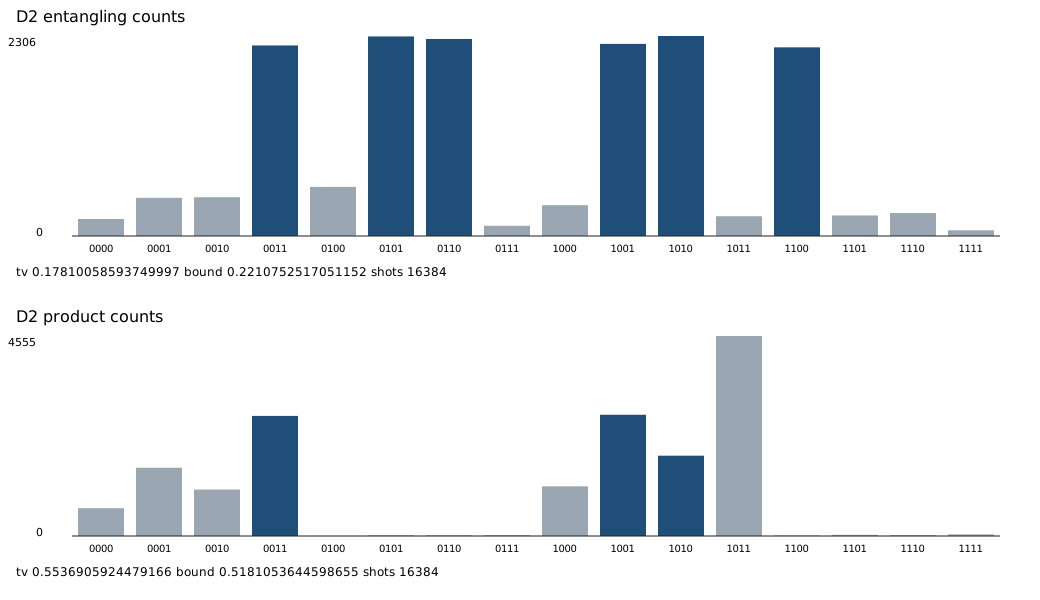
Each circuit took 16384 shots, and each circuit was its own job, so the image test was two jobs. The path is [143,144,145,146]. The compiler's version used 30 two-qubit gates; the hand-built fallback (42) was not needed. The product circuit ran with no CZ. Its frozen probabilities are 0.722804, 0.639348, 0, and 0.639346 on qubits 0, 1, 2, and 3, and its angles are 2.032650, 1.853232, 0.000000, and 1.853228. The six target pictures, in bit order, are 0011, 0101, 0110, 1001, 1010, and 1100. Their entangling-circuit counts are 0011:2197 0101:2301 0110:2272 1001:2215 1010:2306 1100:2175. Those six counts add to 13466. The opening rounds the two total variations. The exact values, and the noise estimate written down before the run, are in Provenance.

Recorded entangling-circuit counts: 0000:196 0001:440 0010:447 0011:2197 0100:566 0101:2301 0110:2272 0111:118 1000:355 1001:2215 1010:2306 1011:228 1100:2175 1101:237 1110:265 1111:66.

Recorded product-circuit counts: 0000:633 0001:1554 0010:1058 0011:2735 0100:3 0101:8 0110:8 0111:19 1000:1131 1001:2761 1010:1829 1011:4555 1100:6 1101:27 1110:20 1111:37.

## Time on the device

IBM reported 16 seconds of quantum time for the three jobs (4, 6, 6).

## Figures

The peak histogram is figures/d1-coherent.svg. The flat histogram is figures/d1-control.svg. The 2x2 image grid is figures/d2-images.svg, with the product circuit in labeled columns beside the target, the simulation, and the hardware. The same counts as bar charts are figures/d2-counts.svg. build_figures.py draws every chart from the score file alone.

## Provenance

The opening rounds the coherent mass to 99.5 percent and its interval to 99.2-99.8 percent, the control mass to 26.5 percent, and the two total variations to 0.178 and 0.554. Every exact value is below.

### Sources

1. Score file sha256 3ceab8cd1d76b2f39d66477cf823c5f438bc180398fb8db389caa5618712531a. The file records published false.
2. Learned-rule prereg sha256 4a8df26365b74338e8b6989d4a4a8a46d5714a8f6c9201c54846ed68e16901e0. Its manifest sha256 is ee63cca5df63d5c043864f2ad5fb5ca694bed44a421f824d8b1cd64397175fa9.
3. Image-test prereg sha256 5abde23b00e76e312bd3dcb778355586373d85897d8e6ecfed42cdd96e1f5ebe.
4. Input copy manifest sha256 f8ff81568c7e998ffb8f7fd7e6614dd8bf90634800d84d92192d2b718a1ca347.
5. Jobs, all on ibm_fez. Learned rule dbk61a9ffo6c73basmm0, form d1_prereg, optimization_level 0, layout [118,150,131,132], cap_s 6, attempt 1, retry false. Entangling circuit dbk61ahffo6c73basmn0, form level1, path [143,144,145,146], 30 CZ. Product circuit dbk61aonceqs73al8gr0, form product_level0, 0 CZ. The compiled entangling histogram is cz 30, measure 4, rz 67, sx 60, x 1. The compiled product histogram is measure 4, rz 12, sx 8.
6. IBM-reported usage per a read-only status query, not a receipt field. The run window is 10:06:15Z-10:06:35Z. The read says "IBM usage per job 4 / 6 / 6 s = 16 s, under the caps 6/32/32. Account: 19 s consumed of 600 in the rolling window, 581 remaining." It lists the jobs as the learned rule, then the entangling circuit, then the product circuit. The dry receipt records usage_remaining 597, submits 0, state DRY_OK, and usage_limit_reached false. That 597 is the pre-run dry field. The dry calibration_hash is 35fb32e4fd239ced69e3ae9f9da0449b003b7a0669e775786fc4e637f5eb4942.
7. The copied live summary records forms, job ids, ok true, refused null, retry false, state CLEAN, and submits 3. It has no used-seconds field.

### Exact values

Learned rule, coherent. mass_k 3058. M 0.9954427083333334, equal to 3058/3072. CP95 lower 0.9923654493901948. CP95 upper 0.9975063144546181. ideal_M 1.0. clears true. verdict_part READY. Off-peak count 14. Off-peak mass 14/3072. gap_m -0.00455729166666663. gap_tv 0.039388020833333336. The gaps are scored false. The simulation histogram is 0.25 on 0000, 0100, 1000, and 1100, and 0.0 on the other 12 bins.

Learned rule, control. mass_k 814. M 0.2649739583333333, equal to 814/3072. CP95 lower 0.24943497916734797. CP95 upper 0.2809616846021007. ideal_M 0.25. clears true. verdict_part READY. gap_m 0.014973958333333315. gap_tv 0.027343749999999993. The gaps are scored false. The simulation histogram is 0.0625 on all 16 bins.

The score rule is CP alpha 0.05 per circuit, conjunction, strict. M = (N_0000 + N_0100 + N_1000 + N_1100) / 3072. PASS only if the coherent lower bound is strictly above 1/2 and the control upper bound is strictly below 1/2. The prereg unmerged coherent count is 16 rz, 8 sx, and 1 cz, with 4 final measures, and the control adds 4 mid-circuit measures and 4 final measures.

Image test. level 0.0015625. tail 0.00078125. The score rule is CP level 0.05/32, half sum-delta, entangling upper below product lower. The entangling simulation histogram is 0.16666666666666666 on the six target strings and 0.0 on the other ten. State-vector total variation of that circuit is 8.326673e-17. Product state-vector total variation is 0.553360309958.

Entangling circuit, hardware. tv 0.17810058593749997. bound 0.2210752517051152. sv_tv 8.326673e-17. gap 0.1781005859374999. half_sum 0.04297466576761522. sum_delta 0.08594933153523043. The gap is scored false. verdict_part READY. bar_upper 0.2210752517051152.

Product circuit, hardware. tv 0.5536905924479166. bound 0.5181053644598655. sv_tv 0.553360309958. gap 0.00033028248991662235. half_sum 0.03558522798805111. sum_delta 0.07117045597610222. The gap is scored false. verdict_part READY. product_lower 0.5181053644598655. separated is true. The product simulation histogram is 0000:0.03605504626995197 0001:0.09401554013804804 0010:0.06391679991404804 0011:0.166666613677952 0100:0.0 0101:0.0 0110:0.0 0111:0.0 1000:0.06391624552204803 1001:0.16666516806995196 1010:0.11330790829395197 1011:0.295456678114048 1100:0.0 1101:0.0 1110:0.0 1111:0.0.

The prereg accepts the level-1 compile only when the semantic overlap is at least 1-1e-9 and the CZ count is at most 42, with seed_transpiler 20261102. The entangling circuit is the Dicke preparation of Bärtschi and Eidenbenz, arXiv:1904.07358 (2019).

The prereg noise estimate, which is not the pass rule, is p=0.01 TV 0.203769910729, p=0.02 TV 0.341815714253, and p=0.03 TV 0.435111704442. The planning cut is 0.316938161089. The hardware total variation of the entangling circuit is 0.17810058593749997.
Figures